

If you’ve ever checked in for a doctor’s appointment, you’ve probably been asked to complete a short questionnaire before seeing your healthcare provider. You may have answered questions like:
- Over the last two weeks, how often have you felt nervous, anxious, or on edge?
- How often have you had little interest or pleasure in doing things?
These aren’t random questions. They come from carefully developed and tested questionnaires called validated assessments.
On unhide®, many of the surveys you complete are based on these same validated assessments. They’re used every day by researchers, healthcare professionals, and health systems around the world to better understand people’s health and experiences.
What is a validated assessment?
A validated assessment is a questionnaire that has been carefully studied to make sure it measures what it is intended to measure. Before researchers or clinicians begin using an assessment, it goes through extensive testing to answer questions like:
- Does it accurately measure the symptom or experience it’s designed to measure? For example, a questionnaire designed to measure pain should accurately reflect a person’s pain levels.
- Does it produce consistent results when completed under similar circumstances? If the same person takes the assessment again under similar conditions, the results should be reasonably similar.
This validation process helps ensure the information collected is reliable, consistent, and meaningful.
Because these assessments have been scientifically evaluated, researchers can compare results across studies, and clinicians can use the results with greater confidence to better understand patients’ symptoms, experiences, and health outcomes.
Sign up for unhide® at no cost.
Why does unhide® use validated assessments?
We use validated assessments because they allow us to collect high-quality, scientifically meaningful data while also giving participants useful information about their own health over time.
Using validated surveys means:
- your responses contribute to research using established scientific methods;
- your scores can be tracked over time to help you recognize changes or trends;
- your results can support conversations with your healthcare provider.
Rather than relying on the narratives of your experiences alone, validated assessments provide a standardized way to measure symptoms and quality of life.
Some of the assessments you may see on unhide® include:
Bodily Functions (COMPASS-31). The COMPASS-31 measures symptoms related to the autonomic nervous system, which controls automatic body functions such as heart rate, blood pressure, digestion, and sweating. It asks about symptoms across six areas, including dizziness when standing, gastrointestinal symptoms, bladder function, and vision changes.
Daily Activities (WSAS-Y Child and Parent). The WSAS-Y measures how much a child’s current health or symptoms interfere with everyday activities. It asks about functioning at school, during daily tasks, in social and leisure activities, and in relationships with family and friends.
Family Impacts: Caregiver Strain (Modified Caregiver Strain Index). The Modified Caregiver Strain Index (MCSI) measures how caregiving responsibilities affect a caregiver’s daily life and well-being. It asks about areas such as emotional stress, physical demands, finances, work, sleep, and personal relationships.
Fatigue Severity Scale (FSS). The Fatigue Severity Scale (FSS) measures how fatigue affects everyday life, including work, physical activity, motivation, family responsibilities, and social activities. It is commonly used in research involving chronic illnesses where fatigue is an important symptom.
Flexibility (Beighton Questionnaire). The Beighton Score measures generalized joint hypermobility, or the ability of joints to move beyond their normal range of motion. It evaluates flexibility in the fingers, thumbs, elbows, knees, and spine using a standardized 9-point scoring system.
Functional Capacity (FUNCAP-27). The FUNCAP-27 measures how health conditions affect a person’s ability to carry out everyday activities. It asks how symptoms, energy levels, and physical or mental activity affect functioning at home, school, work, and in social settings.
Mental Health (GAD-7). The GAD-7 is one of the most widely used questionnaires for measuring symptoms of anxiety. It asks how often you’ve experienced symptoms such as excessive worry, difficulty relaxing, irritability, or feeling nervous during the past two weeks.
Independence Assessment (Lansky Pediatric Performance Scale). The Lansky Pediatric Performance Scale measures a child’s level of independence and daily functioning. It evaluates activity level, through participation in play and the amount of assistance a child needs with everyday activities.
Pediatric Fatigue Severity (PROMIS Parent Proxy Fatigue). The PROMIS Parent Proxy Fatigue questionnaire measures a child’s experience of fatigue based on a caregiver’s observations. It asks about how often a child feels tired, how severe their fatigue is, and how fatigue affects their daily activities.
Overall Health (SF-36) . The SF-36 measures overall health-related quality of life. Rather than focusing on a single symptom, it evaluates eight different areas of health, including physical functioning, pain, energy levels, emotional well-being, social functioning, and general health perceptions. Because it looks at health from multiple perspectives, it is one of the most widely used quality-of-life assessments in medical research.
Get started today at unhidenow.org.
What do my scores mean?
Each validated assessment has its own scoring system. For example, the GAD-7 produces a score from 0 to 21, with higher scores indicating more frequent anxiety symptoms. Researchers have established score ranges that correspond to minimal, mild, moderate, and severe symptom levels. The SF-36 uses a different approach. Scores range from 0 to 100, with higher scores generally reflecting better health-related quality of life across several different domains.
Because every assessment measures something different, scores should always be interpreted according to the specific questionnaire. It’s also important to understand that a score is not a diagnosis. Instead, scores help quantify your responses using standardized methods that have been developed through years of research.
What does “clinically significant” mean?
You may sometimes see the phrase “clinically significant” alongside a score. This does not mean you’ve been diagnosed with a medical condition. Instead, it means your score falls within a range that research has shown may warrant additional attention or discussion with a qualified healthcare professional. It serves as a signal that further evaluation may be appropriate—not as a diagnosis on its own.
What if I don’t see my score(s)?
On unhide®, validated assessments are sent on different schedules. For example, the Mental Health (GAD-7) survey is sent every 3 months, while the Fatigue Severity (FSS) survey is sent every 6 months.
If you don’t see a score for a particular assessment, it may be because:
- You haven’t completed that assessment yet.
- The assessment hasn’t been sent to you yet. Some assessments become available after you’ve been enrolled for a period of time. For example, the Bodily Functions (COMPASS-31) and Flexibility (Beighton Questionnaire) surveys are first sent 1 month after enrollment.
These assessment schedules were carefully designed by the Brain Inflammation Collaborative Research Team to collect the most meaningful research data while minimizing participant burden. We encourage you to complete each survey as it becomes available so we can better understand changes in your health over time.
Using validated assessments to help your health journey
Participating in research doesn’t just contribute to science—it can also help you better understand your own health. Your Validated Survey Results and Trends allow you to:
- track symptoms over time;
- identify changes or trends;
- inform conversations with your healthcare provider;
- better understand how your health may be changing throughout your participation
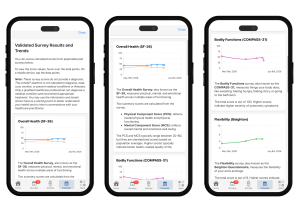
Many healthcare appointments are limited in time. Having a record of your symptoms and trends can help you communicate experiences that might otherwise be difficult to remember or describe.
Your healthcare provider can consider this information alongside your medical history, physical examination, laboratory tests, and other clinical information when determining whether additional evaluation or treatment may be appropriate.
An important reminder:
Although many of the assessments used on the unhide® platform are scientifically validated, they are not intended to diagnose, treat, cure, monitor, or prevent any medical condition or illness. Also, it is important to note that assessments are not automatically validated for every population, setting, or condition. An assessment that works well in one context may not perform the same way in a different group of people or under different circumstances.
Instead, the information generated from these assessments may serve as a helpful tool to support personal health awareness and conversations with healthcare professionals.
Get your validated health survey scores today on unhide®!

Written By
Christina Moon
Clinical Research Assistant, Brain Inflammation Collaborative

